Showing posts with label Skills. Show all posts

Thursday, 13 August 2020

2020 Autumn Conference - Let's get Physical: SPOTLIGHT on POSTGRADUATES

Let's Get Physical - Autumn 2020 
Held on 12th - 16th October 2020: Five days of Physics goodness on: 

POSTGRADUATE RESEARCHER SPOTLIGHT

Celebrating their fantastic work in a Lightning Talk competition

Read about what others thought:

The 2020 Tommy Flowers Network conference “Let’s Get Physical” had a real treat for their special post graduate researcher day.

Opening Keynote
Richard Burguete, NPL, Postgraduate Institute Director
"The Postgraduate Institute of Measurement Science: Celebrating 5 Years of Collaboration "

Richard gave a brilliant overview of NPL with key points: 
  • 5 years of collaboration 
  • They offer impartial and independent advice 
  • They are the UK’s National Metrology Institute 
  • They introduced measure and needs, ensuring fairness in trade and goods. This dates back to Magna Carta 
  • They developed packet switching back in 1966 
  • They created the World’s 1st Caesium Atomic clock in 1955
Richard then went on to discuss their Post Graduate Institute (PGI) which brings together academia and industry to support their 200 PhD students. It’s a way to connect people; understand each other; share problems and solutions and gain a bigger sense and purpose to outcomes and experiences. Very similar to what the Tommy Flowers Network does in BT. 

Then it was ShowTime for the post graduate researchers – a series of 5 minute lightning talks to promote their research. And prizes were up for grabs!

The Judges 
Carol Fletcher, BT, Academic and Research Partnerships
Trevor Linney, BT
Dr Kishore SenguptaJudge Business School, Cambridge University
Dr Philip Stiles, Judge Business School, Cambridge University

It really became clear that the diverse range of topics all have a massive impact on our everyday lives. The energy and passion from each PGR was infectious and their work could feed into BT lines of business plus externally and we will be following up on such opportunities.

Please meet the contestants:

Frank Carver, University of Suffolk
"What do Software Developers Know About Sustainability?"
How a new approach to embed sustainability considerations into software development help could to reduce energy usage. 


Kakia Chatsiou, University of Essex 
"Political text classification using Neural Networks"
Researching the use of neural networks to classify political texts, in particular using COVID-19 briefings from 2020.


Eleanor Crane, UCL/IBM
"From two qubit entangling gates to quantum algorithms, and the steps in-between"
Her research on quantum computing, taking us through an easier way to make qubits.
no slides available


Yi-Tun Lin, University of East Anglia
"Physically Plausible Spectral Reconstruction" 
Using machine learning in spectral reconstruction.


Quantum annealing for network optimisation


Hanna SteventonUniversity of  Suffolk
Smarter Suffolk: Sensors and data for public services
A real-life living lab, and how the data can be used to improve the lives of people living and working in the county.

Whilst the judges were deliberating, we were treated to a lively 

Closing Keynote
Prof Mike Payne, Cambridge University, Department of Physics, The Cavendish Laboratory
"Reflections on a career in science"
 Download slides (.pdf)

Mike's key learning points especially for students and graduates:
  • Find a good solution – not the perfect solution – in tractable time
  • Think about the WHOLE solution and not just the small weakest link
  • Make sure your work stands out from the crowd. How do you do this? Do something others aren’t doing!
  • Get yourself seen – present your work at every opportunity

Congratulations to the Winners
Ella Crane, University College London / IBM
Daniel O'Connor, University College London
Yi-Tin Lin, University of East Anglia

Congratulations to all Lightning Talk presenters for a wonderful performance and bringing this day to live!   
 
The full recording of presentations
Please visit the speaker pages for short bios, downloads and individual recording

2020 Autumn Conference - Let's get Physical: WIRELESS

Let's Get Physical - Autumn 2020
Held on 12th - 16th October 2020: Five days of Physics goodness on: 

WIRELESS

We explore ways to optimise the use of radio frequencies to transmit more data, more reliably and faster, addressing today's and future communication needs

The 2020 Tommy Flowers Network conference “Let’s Get Physical” had a real treat for day two. 

We focussed on Wireless Communications and the work of physicists and engineers who are using the physical properties of the electromagnetic spectrum to extend the capabilities of wireless communications.

Maria Cuevas from BT, Applied Research spoke about how we have seen a four-fold growth in mobile traffic globally in the last 5 years and this growth is set to speed up further.  Maria also explored some use-cases for AI driven radio networks, including distributed Massive-MIMO with cooperative pre-coding, cell-less Massive-MIMO and the control of Intelligent Reflecting Surfaces.

Frank Mullany from Nokia Bell Labs spoke about the need for more hardware flexibility – bandwidth, diverse deployments, spectrum, power consumption, and looked at its practicality.

Robert Piechocki from Bristol University examined wireless systems, self-driving vehicles and digital twins.  Did you know, a digital twin is a virtual living representation of physical entity and can be used for training Machine Learning in mission-critical autonomous vehicles?

This was followed by a lively forum discussion where questions from the audience were put to the speakers. 

 Full recording of presentations and forum discussion.
Please visit the speaker pages for short bios, downloads and individual recordings
 

Speakers 
Maria CuevasBT, Mobile & 5G team
"Wireless Technologies: Emerging Challenges and Opportunities"

Francis Mullany, Nokia Bell Labs, E2E Networking & Service Automation Lab 
"Why Can't Wireless Hardware Be more like Software?"
 
Prof Robert Piechocki, University of Bristol 
"Wireless systems, self-driving vehicles, and digital twins”

Forum
Maria Cuevas, BT, Mobile & 5G team
Francis MullanyNokia Bell Labs, E2E Networking & Service Automation Lab 
Prof Robert Piechocki, University of Bristol 

2020 Autumn Conference - Let's get Physical: OPTICS

Let's Get Physical - Autumn 2020
Held on 12th - 16th October 2020: Five days of Physics goodness on: 

Find out more

OPTICS

We manipulate light for new opportunities, hollow fibres to harvesting light we explore it all

The 2020 Tommy Flowers Network conference “Let’s Get Physical” got off to an amazing blistering start on Monday . This week we’ are showcasing the fundamental role that physics and physicists have in shaping our digital future. For our first day of the conference, Our first day focussed on the study of Optics, and the lives of physicists and engineers who’ are using the physical properties of light to extend the capabilities of optical communications. 

Opening Keynote

Prof Tim WhitleyBT, MD Applied Research and MD of ‘Adastral Park’
"Purposeful Innovation in the age of digital transformation"

Back in 1984, the first commercial single mode optical fibre link from Milton Keynes to Luton was deployed by BT. Since then, customer expectations have changed rapidly – people expect to upload and share material in real time and this continues to drive innovation in the network. A really solid grasp of physics fundamentals continues to ensure that our network can deliver our customers’ expectations. 

We then gained a fascinating insight in to the work of an optical networks researcher with Neil Parker from BT. Neil He described how he brings together internal and external research and engages with business stakeholders, effectively becoming a scientific detective to resolve business problems. Neil explained the different uses of single mode fibre, multi core fibre and hollow core fibres – and gave an intriguing peek in to possible future network architectures. Neil Neil broadcast his presentation from his optics lab at Adastral and the consensus opinion of the several hundred researchers attending the conference was that, without doubt, he has the coolest lab! 

We also heard from Ardel Iddin, Technical Director at ADVA who gave a review of some of the key innovations in optical communications over the past 40 years, and gave us his view of near-term trends. He forecast the evolution of optical communications in the 21st Century - increasing core capacity, wavelength agility and driving fibre to the edge. Ardel concluded the next 5 to 10 years will see fibre extending further into the fixed and mobile access networks at a rapid pace. Continued innovation will be required to achieve the deployment at the required scale and cost. The optical communications industry remains an exciting space to be in, offering the opportunity to build on the innovation of the last 40 years.

Andrew Ellis, Optical Communications Professor at Aston University provided an in-depth focus on an academic career in photonics, and the close parallels with an industrial research career.

We wrapped up the day with a lively open forum debate chaired by Mike Williams. Neil Parker; Ardel Iddin; Andrew Ellis were joined by Alistair Poustie (Founder of Rushmere Technologies) answering questions from the audience.

The full recording of presentations and forum discussio
Please visit the speaker pages for short bios, downloads and individual recording

Speakers 
Prof Andrew Ellis, Aston University
"An 'academic' career in photonics"

"Total Internal Reflections"

Neil ParkinBT, Optics Team
"Optical Research at BT"

Forum
Prof Andrew Ellis, Aston University
Ardel Iddin, ADVA
Neil Parkin, BT, Optics Team
Alistair Poustie, CTO and founder of Rushmere Technology


2020 Autumn Conference - Let's get Physical: DATA SCIENCE & AI

Let's Get Physical - Autumn 2020 
Held on 12th - 16th October 2020: Five days of Physics goodness on: 

DATA SCIENCE & AI

Data is everywhere and it contains hidden secrets - you can uncover them with Data Science

It was an action packed day as the conference culminated with sessions on data science and AI. It was fantastic to be joined by Prof Jesse Thaler, MIT’s Director of The National Science Foundation who presented, “Collision course – AI meets Fundamental Physics”. He talked about deep learning technologies; whether we can teach a machine to think like a physicist; dynamics of Jet formation as well as the fundamentals of physics such as dark matter and astrophysics. Jesse concluded by asking “what principles and strategies from physics could be incorporated into your research in data science and AI?” Let us know what you think in the comments below.

BT’s head of AI and Data Science Detlef Nauck introduced everyone to Data Science & AI within BT. Did you know, BT has the largest AI patent portfolio in the UK and that there are currently over 30 AI activities across BT Research? How amazing is that!

Prof Michael Luck, Kings College London, gave a perspective of AI, stating that you have to solve “The Turing Test” to determine when a machine is determined to be intelligent. He also explored the need for trust; the need for interaction and the need for transparency and accountability.

A lively debate with lots of challenging questions from the audience discussed “How do we know that AI does the right thing?”. Jesse, Detlef and Michael were joined by PwC UK’s Maria Axente and University of Essex’s Prof Lorna McGregor.

The conference was a massive success with over 900 participants from BT, academia and industry. It was recorded and you’ll see some highlights over the next few weeks, so make sure you catch them. Thank you to all those that attended and supported these amazing 5 days.


The full recording of presentations and forum discussion coming soon
Please visit the speaker pages for short bios, downloads and individual recordings (coming soon)

Final Keynote
MIT, Director, NSF AI Institute for Artificial Intelligence and Fundamental Interactions
"Collision Course - Artificial Intelligence meets Fundamental Physics"

Speakers

Detlef NauckBT, Head of AI & Data Science
"Data Science and AI at BT"

Forum
 
Maria Axente, Responsible AI and AI for Good Lead at PwC
Prof Lorna McGregor, Director, ESRC Human Rights, Big Data and Technology Project at the University of Essex
Prof Michael LuckKings College London
Detlef Nauck, BT, Head of AI & Data Science
Prof Jesse Thaler, MIT, Director, NSF AI Institute for Artificial Intelligence and Fundamental Interactions

Full recording of the Data Science & AI presentations and forum discussion

Monday, 17 July 2017

TFInstitute Summer Conference on 'Converged User Experience'

Converged User Experience

How to deliver the connectivity and performance required?


The Tommy Flowers Institute Summer Conference took place 13 – 14 June 2017.
110 people attended over the two days, with students and academics from across 25 universities and senior reps from some of the world’s biggest ICT companies and Innovation Martlesham members including: Ericsson, Huawei, Intel, Cisco and Nokia; Shareband; Cambridge Wireless; Spotless; EPSRC, Innovate UK and Suffolk County Council – who took part in various panel sessions. The event went exceptionally well with excellent feedback from both students and industry.

Mansoor Hanif, Research & Innovation’s Research Director of Converged
Networks opened the conference and presented an informative discussion
looking at “Convergence - Approaching the Singularity”. He described customer drivers and customer expectations; how corporates want converged solutions and look at converging platforms, in particular the customer benefits and the technology that is required.

Mansoor said, “A big part of a truly seamless experience is not having to worry about what network is being used at any point in time. The network and the device should, in conjunction, select the network that can best meet the needs of the services the user is trying to access at any point in time.”


Following panel sessions over the two days with industry, it became clear of the similarities in their ambitions for user convergence.

Key points:
  • Integration of data from a variety of business systems to create a single holistic digital record
  • Ensuring a trusted and safe cyber environment
  • Delivering intelligent technology and systems
  • Enhancing user experience to remain relevant to end users’ needs
  • Collaboration with Industry; Academia and Networks to solve real world problems
An interesting breakout session was set by Research & Innovation’s Mary Lumkin, to look at “What does convergence mean to users?” lively discussions ensued around how convergence could benefit those involved in health and social care (patients, GPs, carers, hospitals and local authorities) and was followed up by ideas of how participants’ research could address some of the challenges identified. Mary said “there are many different organisations that contribute to person centric care, each of whom have different requirements and challenges. Sharing data appropriately, securely and with consent has the potential to achieve positive patient outcomes in a cost efficient way. It is exciting to consider how technologies such as artificial intelligence and machine learning can help to achieve this”.

BT’s Technology, Service and Operation’s MD of Networks - Karl Penaluna – presented a fascinating case study looking at enriching the customer experience through the power of programmability.

Karl discussed how different approaches are needed to succeed and to fully achieve BT’s vision - of providing customers with a real time view in a single pane of glass. He outlined that different ways of working, new skills and a changed industry landscape are required.

“New technologies, coupled with new ways of working allow us to enhance and transform the customer experience”, said Karl. “Converging IT and Network infrastructure and moving from static to programmable networks unlocks services that are truly “on-demand” and by opening up this infrastructure, places customers in control, speeds up deployment and provides consistency of experience. In creating a new Dynamic Infrastructure unit, we have taken a bold step towards this and the first services are being delivered to customer now.”

A trip round Innovation 2017 provided Tommy Flowers Institute members the amazing opportunity to engage with BT and associated companies and explore the technologies and opportunities of the future. Many commented, “I never knew BT did so much innovation”.

BT Research & Innovation’s Head of University Partnerships, Fraser Burton said, “Our ability to convene academia, industry and government to openly discuss shared goals and challenges continues to be a great contribution both to Adastral Park and to BT’s University Research programme, and to the UK’s ICT postgraduate researcher community.”

A key research question that emerged was, given the trend for AI to dynamically manage Quality-of-Experience on a converged infrastructure, how can we understand what the AI has done and why? Exciting times lie ahead for our research community as we tackle the challenges of future networks. The Tommy Flowers Institute Autumn conference is from 26th – 27th September 2017 - focussing on “Security and Trust”.

Downloads:

Tuesday, 4 April 2017

The Tommy Flowers Institute Spring Conference Launches

“Future Organisation – How to build agility and customer focus?”


The Tommy Flowers Institute launched its first conference looking at the Future Organisation. This kicked off the programme of “real-world” conferences.


Prof Tim Whitley, MD of BT Research & Innovation
The Tommy Flowers Institute exists to improve university researchers’ employability, in both industry and academia and thereby enable them to achieve more economic and societal impact – both as individuals and from their research. The Institute is complimentary to what academia can provide, bringing in industrial exposure, opportunities and contacts that just are not available elsewhere – at least not in all one place.

Prof Tim Whitley, MD of BT Research & Innovation said “The Tommy Flowers Institute is focused on the researcher and not just the research. TFI brings together industry and academia to develop the research leaders of the future. These events help galvanize industry to work with world class academic institutions in a new manner, to help generate the research leaders that the nation is going to need”.


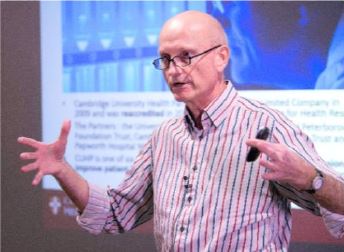
Malcom Lowe-Lauri, Executive Director of the Cambridge University Health Partnership
Malcom Lowe-Lauri,
Executive Director of the Cambridge University Health Partnership
Major industry players including BT, Huawei, 3M, Intel and Adva united to articulate a clear vision of their future organisations and their future skills requirements. Hosted at BT’s global research headquarters at Adastral Park, 30 industrial sponsored PhD and Post-Doctoral researchers received a once in a life time opportunity to quiz the leaders of our industry.

We were joined by Malcom Lowe-Lauri, Executive Director of the Cambridge University Health Partnership who highlighted the importance of building a tech cluster system. Christiane Gruen, MD of 3M UK and Ireland, discussed the challenges of ethically coordinating a global technology initiative.


Christiane Gruen, MD of 3M UK and Ireland
Innovation Martlesham (IM) companies including Rokker; Coderus and Oxems provided the unique viewpoint of smaller and medium sized enterprises. They value being part of the Tech Cluster at Adastral Park, as it provides good opportunities to network. They also value the opportunity to offer projects to students to help them with business challenges. Engaging with TFI gives smaller companies access to bright minds and a great collaboration opportunity.

Industrial case studies were presented by experienced industry practitioners and were analysed in depth by the post grad researchers and academics. This included discussing the challenges of reskilling teams as a result of adopting new technology which dramatically transforms the organisation. Trust and the role of management during change was also discussed.

Breakout session, discussions on whiteboards and tables
Attendees workshopped new approaches to business processes in the context of considering “The Employee Experience in a Future Organisation”. Head of Employee Experience, Sue Hessey, said “there was incredible output from such a short session, underlining the brain-power and engagement of the attendees”.

Specific post grad opportunities were highlighted by the National Physical Laboratory (NPL), The Operational Research Society and European opportunities from EIT Digital. The clear message highlighted the necessity to network; build knowledge; broaden your mind and enjoy it! EPSRC’s Associate Director for Business discussed Skills for Innovation and business inspired training.

small group discussing and networking
The culmination of the event was the post grad researchers taking a leadership role themselves and detailing a clear programme of future conferences, online collaboration, newsletters and journals with enhanced networking opportunities to share research interests and challenges.

BT’s Head of University Partnerships, Fraser Burton said “This conference has been a spectacular success. It’s brought together local and central government, local and global businesses. Plus the very best postgraduate researchers and academics.”

PGR panel session being filmed


Downloads:
separator