Thursday, 27 July 2017

Post Graduate Researcher Profiles – Davide Ferraris


My name is Davide, and I am a doctorate researcher at the University of Malaga, Spain. I am a Marie Curie fellow involved in the NeCS project founded by the European Union's Horizon 2020 research and innovation programme under the Marie Sklodowska-Curie grant agreement No. 675320.
My research topic is about Metrics for Cyber Security focusing on Trust Metrics for the Internet of Things.
The vision of the Internet of Things (IoT) is founded on the following premise: it is possible to create a world-wide network of interconnected objects which will probably be readable, recognizable, locatable, addressable and/or controllable by Internet. Gartner said that billions of devices are foreseen to be connected by 2020, so trust issues will grow exponentially.
A system such as IoT needs trust because the entities involved should know the other entities in the network. This knowledge is the basis to decide if to trust or distrust another entity. The problem of finding a suitable way to establish trust becomes more complicated in IoT due to its heterogeneity and dynamicity. Trust management systems have been used during the decision-making process to assist entities that must interact with others in a system. How to measure trust becomes a key issue for IoT systems also because all the heterogeneous entities will use their own trust management systems. This is one of the main challenges we will have to face in my research.
My research will focus on give to trust measurement a key role on IoT systems, considering trust in the  whole IoT System Life Cycle from the early to the final stages of a System development.

Friday, 21 July 2017

Post Graduate Researcher Profiles - Michael Ojo

My name is Michael and I’m a doctorate researcher at the University of Bournemouth.  My research looks at  the “Architectural Framework for Intelligent Autonomic process management”.  My research work seeks to explore the combination of model-based approaches and artificial intelligence to provide self-sustaining solutions which will have huge impacts on business productivity.


With the advent of BigData and emerging technologies, business processes are becoming more complex with increasing levels of uncertainty.  The applicability of the current approaches to business challenges will soon be completely outpaced by this increasing complexity. Therefore, the need for data-driven system solutions which are smart, flexible, scalable, support dynamic composition and robust in the presence of change, arises.


The aim of autonomic computing is to address complexity inherent in software defined processes, by making processes/ systems to be self-managing.  But  we are in a digital age where innovations, technology, business goal and the cost of managing these business processes  are constantly changing (growing in complexity).  So there is need to develop a new way of applying autonomic computing paradigm to address this growing complexity.  This new way should be applicable to future business processes.


Model driven architecture (MDA) is the technique of defining processes, systems, as  interaction of diagrams or simply pictorial representation. For example if BT have a set of diagrams that describe a product and a code/document that describe the same product, in the future, It will be easier and faster for a BT new recruit to make innovations from that set of diagrams, than code/documents. This makes BT more future-ready for innovations. Technically, code/document is regarded as low-level abstraction while diagrams are termed higher level abstraction.


In a nutshell, we want to look into how we can apply MDA  in an autonomic  process to  improve business processes.

Monday, 17 July 2017

TFInstitute Summer Conference on 'Converged User Experience'

Converged User Experience

How to deliver the connectivity and performance required?


The Tommy Flowers Institute Summer Conference took place 13 – 14 June 2017.
110 people attended over the two days, with students and academics from across 25 universities and senior reps from some of the world’s biggest ICT companies and Innovation Martlesham members including: Ericsson, Huawei, Intel, Cisco and Nokia; Shareband; Cambridge Wireless; Spotless; EPSRC, Innovate UK and Suffolk County Council – who took part in various panel sessions. The event went exceptionally well with excellent feedback from both students and industry.

Mansoor Hanif, Research & Innovation’s Research Director of Converged
Networks opened the conference and presented an informative discussion
looking at “Convergence - Approaching the Singularity”. He described customer drivers and customer expectations; how corporates want converged solutions and look at converging platforms, in particular the customer benefits and the technology that is required.

Mansoor said, “A big part of a truly seamless experience is not having to worry about what network is being used at any point in time. The network and the device should, in conjunction, select the network that can best meet the needs of the services the user is trying to access at any point in time.”


Following panel sessions over the two days with industry, it became clear of the similarities in their ambitions for user convergence.

Key points:
  • Integration of data from a variety of business systems to create a single holistic digital record
  • Ensuring a trusted and safe cyber environment
  • Delivering intelligent technology and systems
  • Enhancing user experience to remain relevant to end users’ needs
  • Collaboration with Industry; Academia and Networks to solve real world problems
An interesting breakout session was set by Research & Innovation’s Mary Lumkin, to look at “What does convergence mean to users?” lively discussions ensued around how convergence could benefit those involved in health and social care (patients, GPs, carers, hospitals and local authorities) and was followed up by ideas of how participants’ research could address some of the challenges identified. Mary said “there are many different organisations that contribute to person centric care, each of whom have different requirements and challenges. Sharing data appropriately, securely and with consent has the potential to achieve positive patient outcomes in a cost efficient way. It is exciting to consider how technologies such as artificial intelligence and machine learning can help to achieve this”.

BT’s Technology, Service and Operation’s MD of Networks - Karl Penaluna – presented a fascinating case study looking at enriching the customer experience through the power of programmability.

Karl discussed how different approaches are needed to succeed and to fully achieve BT’s vision - of providing customers with a real time view in a single pane of glass. He outlined that different ways of working, new skills and a changed industry landscape are required.

“New technologies, coupled with new ways of working allow us to enhance and transform the customer experience”, said Karl. “Converging IT and Network infrastructure and moving from static to programmable networks unlocks services that are truly “on-demand” and by opening up this infrastructure, places customers in control, speeds up deployment and provides consistency of experience. In creating a new Dynamic Infrastructure unit, we have taken a bold step towards this and the first services are being delivered to customer now.”

A trip round Innovation 2017 provided Tommy Flowers Institute members the amazing opportunity to engage with BT and associated companies and explore the technologies and opportunities of the future. Many commented, “I never knew BT did so much innovation”.

BT Research & Innovation’s Head of University Partnerships, Fraser Burton said, “Our ability to convene academia, industry and government to openly discuss shared goals and challenges continues to be a great contribution both to Adastral Park and to BT’s University Research programme, and to the UK’s ICT postgraduate researcher community.”

A key research question that emerged was, given the trend for AI to dynamically manage Quality-of-Experience on a converged infrastructure, how can we understand what the AI has done and why? Exciting times lie ahead for our research community as we tackle the challenges of future networks. The Tommy Flowers Institute Autumn conference is from 26th – 27th September 2017 - focussing on “Security and Trust”.

Downloads:

Friday, 26 May 2017

Post Graduate Researcher Profiles - Sam Tickle

My name is Sam Tickle, and I am a doctorate researcher at the University of Leeds, and my research concerns the detection of change in signals.
 
At first glance this may seem somewhat innocuous and abstract, but the uses for change detection are incredibly ubiquitous, especially for a company such as BT, where spotting a small shift in a single data series in efficient fashion can make all the difference in mitigating a future operational failure, containing a denial of service attack, or simply maximising speed of customer service.
 
Changepoint detection has been used elsewhere to great effect, including, health care, finance, environmental science and large-scale retail. The advent of the Big Data Age, however, has presented something of a challenge for existing changepoint methods, where datasets of interest can have millions of variates in addition to a high density of observations.
 
I am therefore specifically interested in efficient changepoint detection for data streams. This project contains two broad phases
  • The first being to examine the means of speeding up current techniques, and
  • The second to pioneer novel approaches to multivariate changepoint detection.
We have had some success with the first phase already, with potential for real-time high-dimensional change detection now a reality. The paper, and computer package, for this will be appearing soon.

Monday, 15 May 2017

Hanif Mansoor to open the TFI Summer Conference

BT’s Director for Converged Networks - Mansoor Hanif - will open the conference and outline industry initiatives to deliver 100% connectivity and ultra-reliability enabled through converged technology. These include the Telecom Infra Project’s Ecosystem Acceleration Centre, the Future Networks Research Centre and the Lime SDR hackathon.

He will describe how the focus on optimal converged customer experience will lead to a Converged 5G network that is best for customers

Mansoor joined EE in November 2011 and led the technical launch of the 1st 4G network in the UK and was also accountable for the integration of the legacy 2G and 3G Orange and T-mobile networks. Until 2016 he led the team who plan, design, rollout, optimise and operate all EE radio access networks, including Mobile Backhaul and Small Cells, and was accountable for the coverage aspects of EE’s Emergency Services over LTE programme. He was also a board member of MBNL (the joint venture of EE with H3G) until 2016. During the acquisition of EE by BT, Mansoor led the EE network Integration team and is currently Director of the  Converged Networks Research Lab based in BT’s Global Research centre in Adastral Park. He is a member of the BT Technology Steering Board and is a board member of the Scottish Innovation Programme.

Thursday, 11 May 2017

Our 2017 Summer Conference is approaching fast

Our Summer Conference on 'Converged User Experience' is taking place at Adastral Park, Ipswich, on the 13th and 14th June 2017.

Converged User Experience - what is that all about?

One may have heard about 'Converged Networks', a term which says it on the tin and which WhatIs.com describes as:

"Network convergence is the efficient coexistence of telephone, video and data communication within a single network. The use of multiple communication modes on a single network offers convenience and flexibility that are not possible with separate infrastructures. Network convergence is also called media convergence."

Then there is 'Technological Convergence', when different systems or procedures come together in one device or form factor*. 'Convergence' seems to be a key word wherever we look these days, there even is Convergence 2017 a music, art and technology festival in London.

So, bringing things together, building context, cross-pollinate between previously unrelated subjects, building, creating, enabling is what it is about, in whichever way or form, and the world of ICT is the medium it thrives on. 

As an organisation that aims to bring academic expertise together with industrial power to create a better world for people, we identified the subject of 'Converged User Experience' as one of the big strategic challenges.

Fixed, mobile and IoT (Internet of Things) infrastructures are coming together as technology evolves, but it is the user who remains the point at which all this technology truly converges. It is the experience of the user that matters. Network engineering and data science combine in order to serve the users' need to communicate with each other wherever and whenever, to be entertained, and to control their environment on the switch of a button. 

The ICT industry faces and ongoing challenge to cost-effectively deliver the connectivity and the performance required. 

The Tommy Flowers Institute Summer Conference will address this challenge. We have fantastic speakers lined up and participants will have the opportunity to network and input their expertise in break out sessions. Additionally participants will have the opportunity to visit Innovation 2017, BT's major technology exhibiton.


*quote from WhatIs.com 

Tuesday, 4 April 2017

The Tommy Flowers Institute Spring Conference Launches

“Future Organisation – How to build agility and customer focus?”


The Tommy Flowers Institute launched its first conference looking at the Future Organisation. This kicked off the programme of “real-world” conferences.


Prof Tim Whitley, MD of BT Research & Innovation
The Tommy Flowers Institute exists to improve university researchers’ employability, in both industry and academia and thereby enable them to achieve more economic and societal impact – both as individuals and from their research. The Institute is complimentary to what academia can provide, bringing in industrial exposure, opportunities and contacts that just are not available elsewhere – at least not in all one place.

Prof Tim Whitley, MD of BT Research & Innovation said “The Tommy Flowers Institute is focused on the researcher and not just the research. TFI brings together industry and academia to develop the research leaders of the future. These events help galvanize industry to work with world class academic institutions in a new manner, to help generate the research leaders that the nation is going to need”.


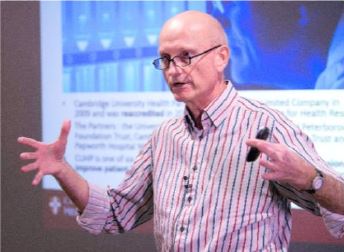
Malcom Lowe-Lauri, Executive Director of the Cambridge University Health Partnership
Malcom Lowe-Lauri,
Executive Director of the Cambridge University Health Partnership
Major industry players including BT, Huawei, 3M, Intel and Adva united to articulate a clear vision of their future organisations and their future skills requirements. Hosted at BT’s global research headquarters at Adastral Park, 30 industrial sponsored PhD and Post-Doctoral researchers received a once in a life time opportunity to quiz the leaders of our industry.

We were joined by Malcom Lowe-Lauri, Executive Director of the Cambridge University Health Partnership who highlighted the importance of building a tech cluster system. Christiane Gruen, MD of 3M UK and Ireland, discussed the challenges of ethically coordinating a global technology initiative.


Christiane Gruen, MD of 3M UK and Ireland
Innovation Martlesham (IM) companies including Rokker; Coderus and Oxems provided the unique viewpoint of smaller and medium sized enterprises. They value being part of the Tech Cluster at Adastral Park, as it provides good opportunities to network. They also value the opportunity to offer projects to students to help them with business challenges. Engaging with TFI gives smaller companies access to bright minds and a great collaboration opportunity.

Industrial case studies were presented by experienced industry practitioners and were analysed in depth by the post grad researchers and academics. This included discussing the challenges of reskilling teams as a result of adopting new technology which dramatically transforms the organisation. Trust and the role of management during change was also discussed.

Breakout session, discussions on whiteboards and tables
Attendees workshopped new approaches to business processes in the context of considering “The Employee Experience in a Future Organisation”. Head of Employee Experience, Sue Hessey, said “there was incredible output from such a short session, underlining the brain-power and engagement of the attendees”.

Specific post grad opportunities were highlighted by the National Physical Laboratory (NPL), The Operational Research Society and European opportunities from EIT Digital. The clear message highlighted the necessity to network; build knowledge; broaden your mind and enjoy it! EPSRC’s Associate Director for Business discussed Skills for Innovation and business inspired training.

small group discussing and networking
The culmination of the event was the post grad researchers taking a leadership role themselves and detailing a clear programme of future conferences, online collaboration, newsletters and journals with enhanced networking opportunities to share research interests and challenges.

BT’s Head of University Partnerships, Fraser Burton said “This conference has been a spectacular success. It’s brought together local and central government, local and global businesses. Plus the very best postgraduate researchers and academics.”

PGR panel session being filmed


Downloads:
separator